Plumbing in Los Angeles is not one market. A 1960s apartment block in Koreatown, a 1940s hillside house in Echo Park and a 1960s home near the airport all sit inside the same city and the same rules, yet they fail in different ways and are fixed by different people. This page explains the differences that matter, then points to a page for each of 12 neighborhoods. For the service overall, start at the home page.
How does plumbing differ between Los Angeles neighborhoods?
It differs mainly by building age, building type and who owns the pipes. Older neighborhoods have older supply and drain lines. Apartment-heavy ones put dozens of households on shared stacks and risers. Hillsides change water pressure and make access harder. The city rules are the same everywhere, but the typical job, and who decides to fix it, is not.
Census Reporter's ZIP code profiles show the pattern clearly. The typical home in Echo Park's ZIP, 90026, was built in 1945. In West Adams, 90016, the median build year is 1949 and roughly two in three homes date from 1959 or earlier. In Hollywood, 90028, and Mar Vista, 90066, the typical building is closer to 1967. Age matters because pipe materials changed over the decades, and the repiping guides cover what to expect from galvanized pipe in older houses and the later plastic that caused its own trouble, in the page on polybutylene replacement.
Terrain adds another layer. Water pressure falls as a house sits higher above the main, by about 1 psi for every 2.31 feet of rise, so neighbors on one hillside street can see different readings. That is why the low water pressure guide starts with a gauge, not a guess.
Which neighborhoods have their own page?
Twelve areas now have a page of their own, each written around that neighborhood's housing and ZIP code data from the Census. They are listed here, in no particular order, each with the single fact that most shapes the plumbing there.
- Hollywood: ZIP 90028 has 18,170 renting households out of 18,807, so shared stacks and landlord-controlled repairs dominate.
- Koreatown: in ZIP 90005 only about 5 in 100 homes are houses, and about 91 in 100 households rent.
- Silver Lake: about half the 13,454 homes in ZIP 90039 are houses, and around 61 in 100 pre-date 1960.
- Echo Park: the typical home dates from 1945, and about three in four households rent.
- Highland Park: ZIP 90042 has similar housing age to Silver Lake but a median home value of $976,400.
- Eagle Rock: only about 45 in 100 households in ZIP 90041 rent, so owners hire plumbers themselves.
- Boyle Heights: about 82 in 100 households in ZIP 90033 rent, in homes built mostly in the 1950s or earlier.
- West Adams: a third of the 19,955 homes in ZIP 90016 are houses, the rest mostly small apartment buildings.
- Westchester: ZIP 90045 splits roughly half houses, almost a third in buildings of 20 or more units.
- Miracle Mile: ZIP 90036 has about 86 in 100 households renting, next to the highest median home value in this set, $1.88 million.
- Los Feliz: about 22 in 100 of the 24,463 homes in ZIP 90027 are houses, mixed with older apartment blocks.
- Mar Vista: fewer than half the 27,045 homes in ZIP 90066 pre-date 1960, so the stock is newer than the Eastside.
A ZIP code is not a neighborhood boundary, and the figures describe the ZIP, not every street. If your address sits near an edge, read the neighboring page too.
Who is responsible for the plumbing: the renter, the owner or the landlord?
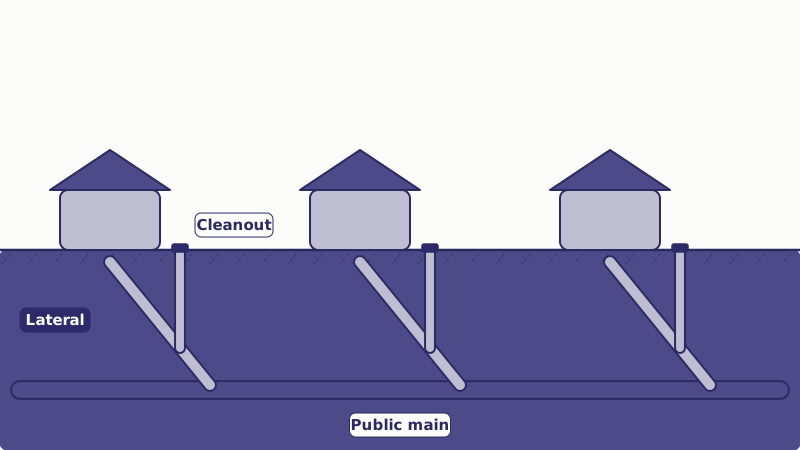
It depends on where the pipe is. Inside your own unit, the owner of the unit, or the landlord if you rent, answers for fixtures and supply lines. Shared stacks, risers and the building's water heater belong to the building owner. The private sewer lateral belongs to the property owner, and LA Sanitation looks after the public main.
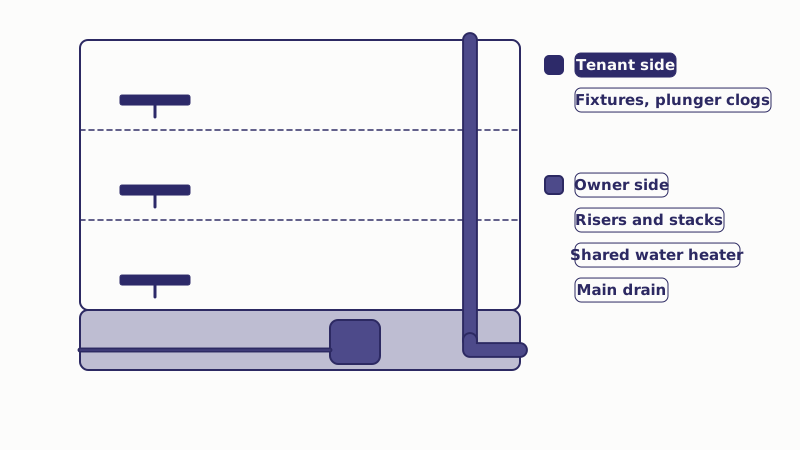
That last point surprises people. In the City of Los Angeles the owner is responsible for the private lateral from the building to the street connection, according to LA Sanitation. If sewage comes up in several units at once, or in the street, the blockage may be in the main, and 311 is where to report it.
In renter-heavy areas like Koreatown, Hollywood and Boyle Heights, the person who calls about a problem is often not the person who pays for it. The apartment building no hot water page covers what renters can do when a shared heater fails. For a landlord or manager, the commercial plumber service page covers multi-unit and business buildings.
What do older Los Angeles homes need from a plumber?
They tend to need supply line attention first and drain attention second. Many houses from before 1960 were built with galvanized steel or copper supply pipe and cast iron drains. Galvanized pipe corrodes from the inside and loses flow. Copper can develop pinhole leaks. Cast iron drains can crack or scale. Which of these your home has is a question for a camera and a plumber, not a guess.
If one leak has already happened, the repipe a house page explains when replacing the whole line is cheaper than chasing leaks one at a time. A remodel is often the moment it comes up, because opening walls makes the work cheaper, and the bathroom remodel plumbing page covers what to plan.
Water quality matters too. LADWP says its water is safe to drink, but its hardness differs by area. Its Water Quality FAQ, using 2022 data, gives averages of 8.6 grains per gallon for the San Fernando Valley and western Los Angeles, 9.8 for Silver Lake, Downtown and South Los Angeles, and 16.3 for eastern Los Angeles and the Harbor. Hard water builds scale in heaters and on fixtures, which is what the page on removing hard water scale deals with.
Which city rules apply in every neighborhood?
All 12 neighborhoods are inside the City of Los Angeles, so the same agencies apply. LADBS issues plumbing permits, and it requires a permit to replace a gas water heater in a single-family home. LADWP supplies the water. LA Sanitation runs the public sewers. SoCalGas serves gas, and a gas leak means leaving the building and calling 1-800-427-2200 from outside.
California also sets the licensing rule. A plumbing contractor needs a C-36 license from the Contractors State License Board for work worth $over $1,000 once labor and materials are added, or any job that needs a building permit. Check the number at cslb.ca.gov before anyone starts.
Two rules come up repeatedly in the guides. LADBS requires an approved seismic gas shut off valve when a building permit worth $10,000 or more is issued for a building with fuel gas piping, as the earthquake valve page explains. And the water heater permit page shows how the permit works for a replacement.
What do plumbing jobs cost across Los Angeles?
Published guides put a Los Angeles plumber at about $100 to $200 an hour before parts and fees. We found no source that publishes prices by neighborhood, so these are city-wide guides. A hillside driveway, a third-floor unit or a permit can add time, but those are job factors, not neighborhood prices.
| Job | Guide range | Page |
|---|---|---|
| Plumber, hourly | $100 to $200 | plumber cost |
| Unclog a toilet | $110 to $275 | toilet clog cost |
| Gas line, short run | $260 to $820 | gas line cost |
| Water heater, tank, installed | $881 to $1,826 | water heater cost |
| Slab leak, spot repair | $2,000 to $4,500 | slab leak cost |
| Whole-house repipe, PEX | $4,000 to $10,000 | repipe cost |
These come from published price guides by Angi, HomeGuide and CostHelper, as summarized on the linked pages. They are a guide only. The real price is the written quote from the plumber who visits, which you can ask for through the quote page.
Common questions
Do prices change between areas of Los Angeles?
Not by a published scale. The city-wide guide is about $100 to $200 an hour. What varies is the job: older pipe that is hard to reach, a steep driveway, a unit on an upper floor or a permit can all add time. Your written quote reflects your address and your pipes, not a neighborhood rate card.
Does the service cover my neighborhood if it is not listed?
The service covers the City of Los Angeles, not only the 12 neighborhoods with pages. If your address is in the city, ask for a quote. If you are close to a boundary, say so in the request, because a few places with Los Angeles mailing addresses sit in separate cities with their own permit offices.
Who do I call if the sewer backs up in my street?
If sewage rises in the street or in neighbors' homes too, the public main may be blocked. Report it through 311 so LA Sanitation can respond. If it is only your property, the private lateral is the owner's responsibility, and a plumber can camera the line to find where the blockage sits.
Do I need a permit for plumbing work in Los Angeles?
For many jobs, yes. LADBS requires a permit to replace a gas water heater in a single-family dwelling, and larger jobs like repiping, gas work and moving fixtures also generally need one. Ask your plumber who pulls it and what it costs before you agree. The water heater permit steps are set out in the guides.
Are the neighborhood figures exact?
They come from Census Reporter ZIP code profiles, so they describe the ZIP code, not an exact neighborhood boundary, and they are survey estimates. Treat them as a picture of the housing, not a count of your street. The page for each neighborhood links the profile it used.