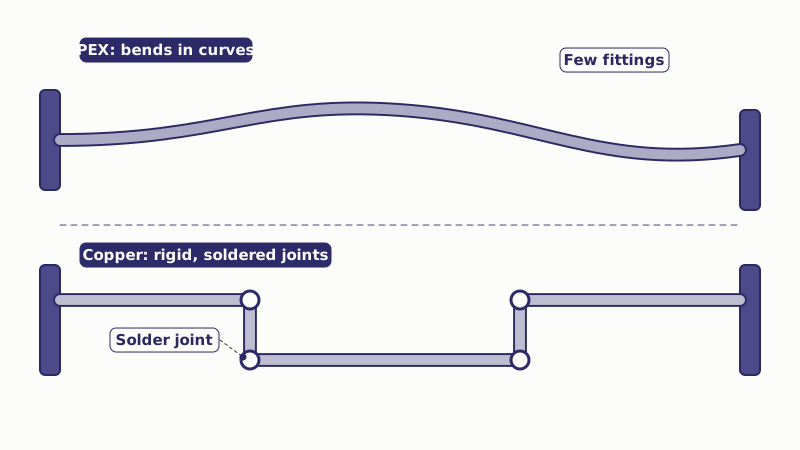
For most Los Angeles houses PEX is the practical pick: it is roughly 40 to 60 percent cheaper than copper on a whole-house repipe, faster to install and it does not corrode. Copper is a good pipe too and is the better choice for exposed or hot runs and for owners who want a metal system. If you are planning the whole job, start with repiping a house in Los Angeles.
Is it better to repipe a house with PEX or copper?
For most houses, PEX. It costs less, needs fewer wall openings and resists the corrosion that kills older pipe. Copper is better where there is heat or sun, where a buyer expects metal or where it must match existing copper. Both pass LADBS inspection when installed right, so the right choice depends on the house and the budget.
Think about the old pipe you are replacing. If it is galvanized steel or polybutylene, PEX or copper both fix the problem, and the cost gap decides it. If it is copper that has pinholed, ask why: water chemistry can attack copper in some places, and PEX avoids that failure. Page pinhole leaks in copper pipe goes through the causes.
If you want to sell soon, ask a local agent whether buyers in your area care. Many do not care once the pipe is permitted and inspected.
How much does PEX cost compared with copper?
On a 2,000 square foot, two-bath house, published guides put PEX at about $4,000 to $10,000 and copper at about $8,000 to $18,000. Copper commonly costs 40 to 60 percent more, and some guides say close to double. Per foot, half-inch copper runs about $2 to $4 and PEX about $0.50 to $1.
The pipe is the small part. Labor is the larger part, and copper needs more of it: every elbow and tee is soldered, and the pipe is rigid so it needs more access. A copper repipe commonly takes three to seven days against one to three for PEX. That also means more patching.
For the full picture of what drives each figure, see repipe house cost and PEX repipe cost.
Which lasts longer, PEX or copper?
Copper is commonly rated at 50 to 70 years and PEX at 40 to 50 years or more, though guides disagree, with some giving PEX as low as 25 years. Both depend on water chemistry and on installation quality. Sunlight, bad fittings and aggressive water cut either one short.
Copper can last longer but has a known weakness in some water: pinhole leaks from acidic or heavily chlorinated water. PEX does not corrode and resists chlorine, but it degrades in ultraviolet light and its fittings are the usual failure point. LADWP is expanding chloramine across its system and reports hardness from about 9 grains per gallon in the Valley and Western LA to about 16 in Eastern LA and the Harbor, so scale builds in some areas.
Neither pipe fails at a set age. The installer, the fittings and the water set the real life.
How does flow compare, 1/2 inch PEX against 1/2 inch copper?
Half-inch copper flows slightly more than half-inch PEX, because PEX has a smaller inside diameter and fittings that sit inside the tube narrow it more. In a house you usually do not notice, because plumbers size trunk lines and branches to make up for it. We could not open a reliable published flow chart, so we will not print one.
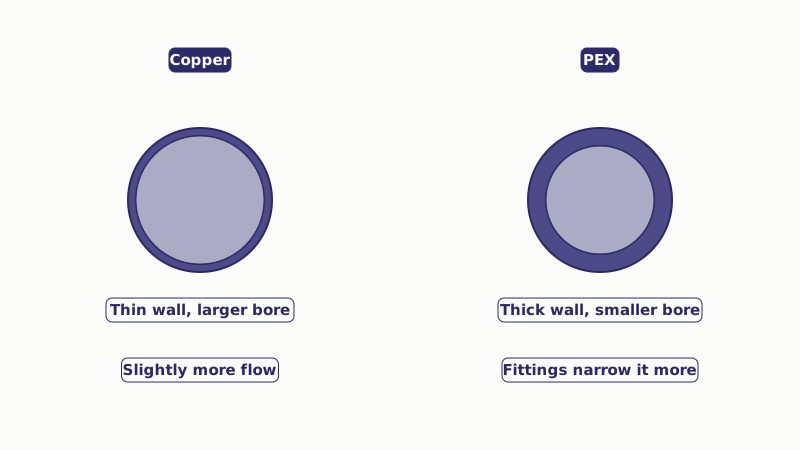
What matters is the design. A three-quarter-inch trunk to a manifold, with half-inch branches, gives normal pressure at every fixture in most houses. A house with long runs or many fixtures on one branch needs more thought, and so does a hillside house at the end of a low-pressure street. If pressure is the complaint, the page on low water pressure covers other causes before you spend on pipe.
Expansion fittings on PEX-A restrict flow less than crimp rings on PEX-B, covered in PEX A versus PEX B.
How do PEX and copper handle cold weather, heat and sunlight?
PEX handles freezing better because it can expand without splitting, though repeated freezing damages it and the fittings are the weak point. Copper splits when water freezes. Copper handles heat and sunlight much better than PEX, which should not sit in direct sun. Los Angeles rarely freezes hard in the basin, but it does in some hills and desert-edge areas.
For Los Angeles the heat point is more useful than the freeze point. Hot attics are fine for rated PEX, but runs near a water heater flue or a recessed light need clearance. Outdoor stubs and hose bibs are usually copper or brass for sun reasons. If you live where nights drop below freezing, insulate any run in an exterior wall or an unheated space, whichever pipe you pick.
What about PVC and CPVC against PEX and copper?
PVC is not rated for hot water, and it is mostly used for drains and vents. CPVC is a rigid plastic made for hot and cold water and is an alternative, but it can become brittle with age and is used less in repipes now. The real choice for most houses is PEX or copper.
If a house has CPVC and it is cracking, that is a repipe question too. Cast iron is a separate matter, because it is used in drains, not supply. Many Los Angeles houses from the 1920s to 1950s have galvanized supply and cast iron drains, and a repipe changes the supply only.
What does a repipe need in Los Angeles regardless of pipe?
A LADBS plumbing permit and an inspection before walls close, a plumbing contractor, a pressure test and a pressure regulator if static pressure is over 80 psi. Whichever pipe you pick, ask for these in writing. Check the contractor at cslb.ca.gov. The details on process and timing are in the main repipe guide.
Ask the plumber which pipe they would pick for your house and why, and whether they would price both. A good answer ties the pick to your access, your water pressure and your budget. A pick made only on what the crew prefers is not an answer. If you are weighing the job against doing nothing, why repipe a house lists the signs.
Common questions
Is PEX better than copper?
Not across the board. PEX is cheaper, faster and does not corrode, and copper lasts longer in the right water, handles heat and sunlight and has a longer track record. For most Los Angeles repipes PEX wins on cost and access, and copper wins where the pipe is exposed or hot.
How long does PEX last compared to copper?
Guides give PEX at 40 to 50 years or more and copper at 50 to 70 years, though some publish lower numbers for PEX. Water chemistry, sunlight and installation quality matter more than the label. Neither lasts forever, and neither fails on a schedule.
Does PEX freeze and burst in cold weather?
PEX can freeze, but it expands and is much less likely to burst than copper. Repeated freezing can still weaken it, and the fittings are the weak point. Los Angeles rarely hits hard freezes, but insulate pipes in exterior walls and hillside crawl spaces.
Is PEX safe for drinking water?
PEX sold for drinking water must meet NSF standards for potable water. California reviewed health questions before approving it for the state plumbing code, and a court case in 2009 and 2010 forced a second review. If you notice a taste on new lines, flush them for a while.
Which is better for an old house, PEX or copper?
PEX is usually easier in an old house, because it bends through plaster walls and needs fewer openings. Copper can be the better match if the house already has good copper or if you want to keep the original character of exposed runs. Both need a permit and inspection in Los Angeles.
To compare real numbers on your own house, use the quote page and a local plumber will come to you.