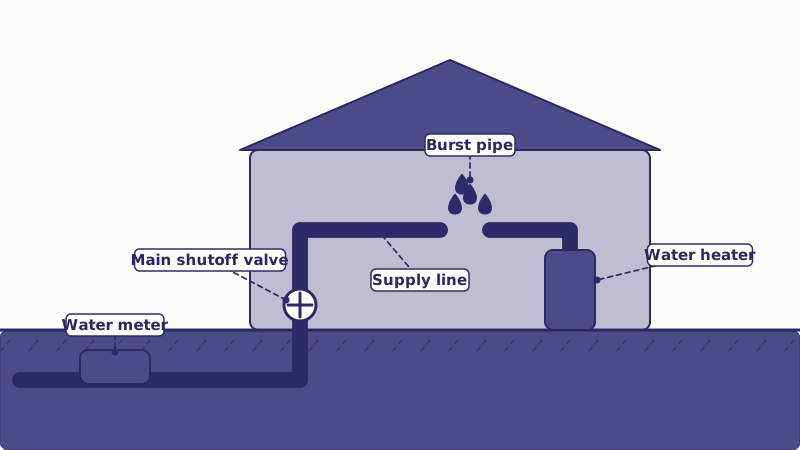
In a plumbing emergency, stop the water first, then call. Shut off the main valve where the line enters your house, keep clear of electricity, and call a plumber for the repair. If you smell gas, leave the building and call SoCalGas at 1-800-427-2200 from outside. After-hours plumbing in Los Angeles is commonly priced at 1.5 to 3 times the normal rate in published guides. The plumber home page lists everything else we arrange.
What counts as a plumbing emergency?
An emergency is any problem where waiting makes damage or danger worse: a burst or spraying pipe, water coming through a ceiling, sewage backing up into a tub or floor drain, no water at all, a water heater leaking steadily, or any gas smell. A dripping faucet or slow drain is urgent to you but can usually wait for morning.
Whether a business is family-owned or a larger company matters less than the price and the arrival time you are told on the phone. A fair test of urgency is this: can you contain it with a valve or a bucket? If closing the fixture stop or the main stops the problem, you have bought time, and a daytime visit is cheaper. If water keeps coming, or the problem is inside a wall or under the floor where you cannot reach it, treat it as an emergency.
Gas is different from water. A gas smell is a leave-now situation, not a plumbing appointment. See the gas steps further down.
What should I do first when a pipe bursts?
Shut off the main water valve, turn off the water heater, open a faucet at the lowest point to drain the lines, and move belongings and electronics away. Then call. The main valve is where the supply line enters your home, often in a garage, a utility closet or on an exterior wall near the front.
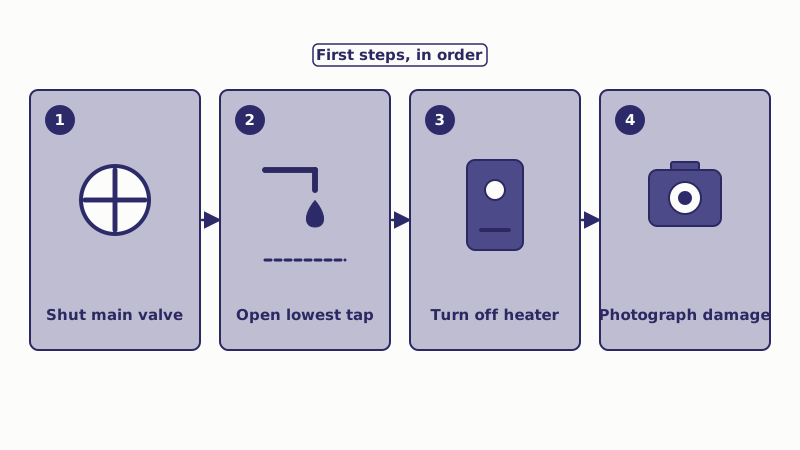
Do it in this order:
- Main valve. Turn it clockwise until it stops. A lever valve closes with a quarter turn. The meter at the curb belongs to the utility, so use the valve on your side, at the house.
- Heater. Switch the water heater to off or pilot, so it is not heating an empty tank. For electric, switch the breaker off.
- Drain. Open the lowest faucet and flush a toilet to relieve pressure.
- Contain. Move rugs and electronics, soak up water, and photograph the damage for your records.
- Call. Give the plumber the location, what you shut off, and whether anyone is hurt.
If the main valve will not close, or you cannot find it, tell the plumber that on the phone. A valve that is seized or leaking is a failure of its own, and the plumber will bring a replacement. Our emergency plumber for a burst pipe page covers that job in more detail, and how to know if a pipe burst covers hidden ones.
My water pipe is leaking under my house. What should I do?
Shut off the main valve, then look for the source from a safe spot. A pipe leaking under a raised foundation can usually be traced by dripping, wet soil or a damp smell. A leak under a slab often shows as a warm floor, a hissing sound or a meter that keeps moving. Call a plumber, and do not crawl into standing water near electricity.
LADWP says to check for a leak by turning off all water, indoors and outdoors, and watching the leak gauge on your meter. If it moves with everything off, water is going somewhere. That test tells you whether the leak is real, but not where. A leak detection visit uses equipment to find the spot without tearing up floors. Pricing is on plumber leak detection cost.
In Los Angeles, many older homes sit on raised foundations with galvanized or copper supply under the floor, while newer ones are often on slabs. Slab leaks need a plumber and sometimes a concrete cut, covered under slab leak repair cost. If the crawlspace has standing water, stay out of it and call for help, since electrical wiring often runs there.
How much should a plumber cost to fix a leak?
A simple leak repair is often a few hundred dollars. A national guide puts the average plumbing repair near $340, with most homeowners paying roughly $180 to $500. Burst pipe repair, plumbing only, runs about $500 to $4,000 in published guides, before water damage cleanup. Emergency timing adds a surcharge.
What decides it: whether the pipe is reachable, how many sections failed, the pipe material, and whether a permit is needed. A pinhole in an exposed copper line is a short job. A split in a galvanized pipe inside a finished wall means opening drywall, and old pipe often fails again next to the repair. For that case, ask about replacing a longer run rather than patching. More on prices is on plumber cost.
How much do emergency plumber costs run after hours?
Published guides put after-hours and emergency work at about 1.5 to 3 times the standard rate, with hourly figures around $200 to $400, and emergency call-out fees of roughly $89 to $350. Ask for the surcharge and the call-out fee before the plumber is sent, and whether either is credited toward the repair.
Prices vary by hour of the day, the day of the week, and how quickly you need someone. A Sunday night call costs more than a Monday morning one. If you have contained the water, waiting for the next business day often cuts the bill, and the plumber can still find the failure then. If water keeps coming, do not wait for the lower rate. Routine maintenance, such as exercising the main valve once a year, means it works when you need it.
The details on the fee are in plumber service call cost. California requires a written contract for home improvement work over $500 and caps the down payment at $1,000 or 10 percent of the contract price, whichever is less, so be wary of an emergency plumber who asks for large cash up front.
How long does a plumber usually take to fix a leak?
A leak in an accessible pipe is often a visit measured in hours, and a leak in a wall, a slab or a buried line can take a day or more because of access and repair afterward. Ask for an estimate when the plumber diagnoses it. The repair, the drying and the finish work are separate stages.
The first visit usually finds the leak and stops it, with the plumber cutting out the failed section and fitting new pipe or a coupling. If a permit is needed, an inspection follows. Drywall, paint and flooring repair come later and are usually separate trades, as is drying out the affected area.
Is there a 24-hour emergency plumber near me?
Some businesses answer around the clock, and some do not. We arrange plumbing across the City of Los Angeles, and whether a plumber can come at a given hour depends on who is available. Our contact hours are on the contact page, and you can request a plumber on our quote page. We do not promise a response time, so ask when you call.
People search for 247 emergency plumbers and 24-hour plumbers open now. Whatever you pick, confirm three things on the phone: whether a surcharge applies, whether the arrival time is a window or a promise, and whether the plumber will state the price before starting.
This site covers the City of Los Angeles. Pasadena and Lancaster are separate cities, so for those, and for places like Philadelphia, Mesa, Frisco or Arvada, you need a local plumber there. If you are in Los Angeles, the neighborhoods we cover are listed on one page.
What about gas, electricity and sewage?
Gas, electricity and sewage each have their own rules. For gas, leave the building, then call SoCalGas at 1-800-427-2200 from outside, and call 911 if damage may endanger life. Do not use switches, lighters or phones inside, and do not try to fix gas pipe yourself. Electricity and water do not mix, so stay away from wet panels.
SoCalGas also says that after an earthquake you should turn off the gas meter only if you smell gas or hear a leak, and that you should not turn it back on yourself. Call SoCalGas to restore service. Our emergency gas shut-off valve for earthquakes page explains the valve. For sewage, keep children and pets away, do not run more water, and avoid contact. Call a plumber and treat the area as contaminated until it is cleaned.
If water is near the electric panel or outlets, do not touch them with wet hands. If you can reach the breaker without standing in water, switch off the affected circuits. Otherwise call 911 and your utility.
Common questions
What is a plumbing inspection?
It can mean two things. One is the city inspection after permitted work, where an inspector checks the new plumbing at rough-in and final stages. The other is a plumber's inspection of existing pipes, sometimes with a drain camera, to look for leaks or damage. The second one is common before buying a house. Prices are on plumbing inspection cost.
What is the 135 rule in plumbing?
It is a drain layout guideline: a drain line needs a cleanout once its direction has changed more than 135 degrees in total, and plumbers prefer two 45 degree bends to one sharp 90. Wording differs between sources, and the local code decides. It matters when a plumber is clearing or rebuilding a drain.
What is the most common plumbing service call?
Clogged toilets and drains top most published lists, then leaking faucets and pipes, running toilets, and water heater problems. Emergency calls are more often burst pipes, sewage backups, and water heater leaks. A call that starts as a small drip turns into an emergency when it is left to run for a weekend.
How to tell if a plumber is ripping you off?
Warning signs: no license number, no written quote, a price that changes at the door, pressure to decide at once, a demand for a large cash deposit, and no willingness to show you the failed part. California caps the down payment at $1,000 or 10 percent of the contract, whichever is less. Check the license on the CSLB site.
Does insurance pay for an emergency plumber?
It depends on your policy. Sudden, accidental water damage is often covered, and slow leaks or wear often are not, but terms differ, so read yours or call your insurer. Take photos, keep the plumber's invoice, and stop the water first. See whether insurance covers a burst pipe for what to ask.