Plumber service covers anything that carries water or waste in or out of your home: leaks, clogs, toilets, faucets, water heaters, pipes, gas lines and fixtures. In Los Angeles, a visit typically costs about $100 to $200 an hour plus a call-out fee, according to published guides. We arrange the visit, a local plumber comes to you, and you get the price in writing first. The plumber home page lists every job.
What is the 135 rule in plumbing?
The 135 rule is a drain-layout guideline, not a law with one official wording. In the version most tied to code, a drain line needs another cleanout once its direction changes by more than 135 degrees in total. A 90 degree turn plus a 45 degree turn is 135. Check the plumbing code your inspector uses.
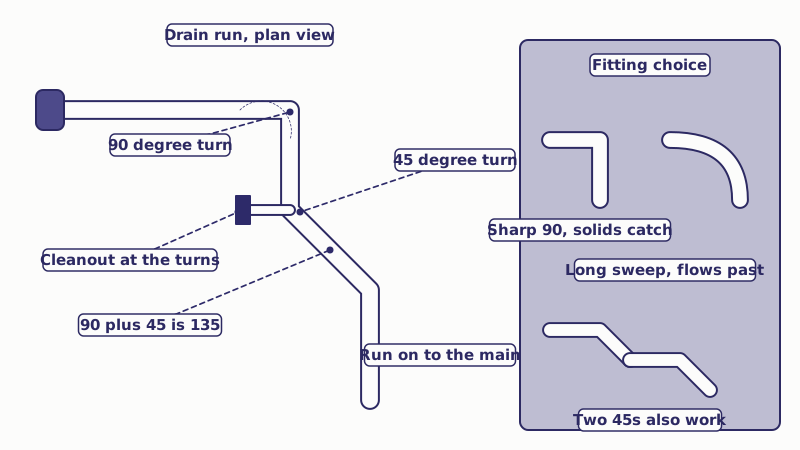
Other versions say a horizontal drain should not turn more than 135 degrees at one fitting, which is why plumbers use two 45 degree elbows or a long-sweep fitting instead of a sharp 90. The reasoning is the same: gentle bends keep solids moving and let a snake pass through. The sources differ on the exact wording, and Los Angeles uses its own plumbing code adopted from the Uniform Plumbing Code, so the plumber and inspector decide. You do not need to apply it yourself. It matters when you open walls or add a bathroom.
What is the most common plumbing service call?
Clogged drains and toilets lead published lists, followed by leaking faucets and pipes, running toilets, water heater trouble and low water pressure. Most are short jobs. A plumber can often diagnose and fix a clog or a worn fill valve in one visit, which keeps the cost near the lower end of the range.
If you want to try first, a plunger and a drain snake solve many clogs, and a flapper or fill valve is an inexpensive part. The steps are in how to repair a toilet that keeps running and how to unclog a kitchen sink. Call a plumber when more than one drain backs up, when a leak is inside a wall, or when the problem comes back after you fix it.
What are three types of plumbing?
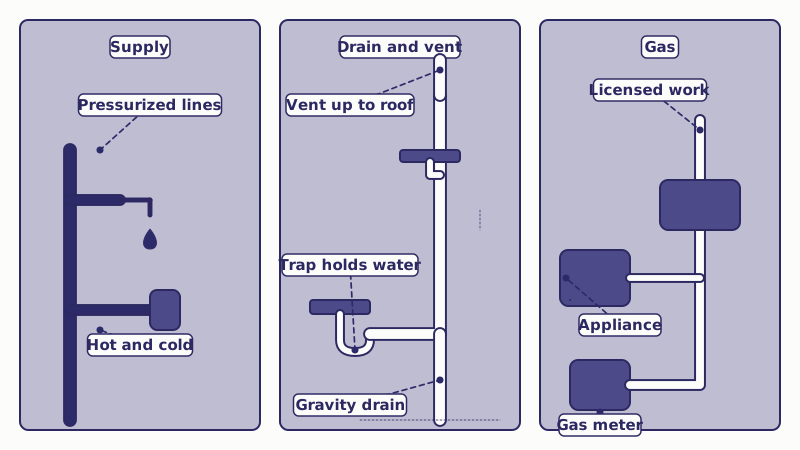
Residential plumbing is usually grouped into three systems: water supply, drainage, and gas. The supply system brings pressurized hot and cold water to fixtures. The drain-waste-vent system carries waste out and lets air in so drains flow. Gas piping fuels water heaters, stoves and furnaces.
Each has different rules. Supply lines are under pressure, so a failure leaks quickly. Drains work by gravity and need slope. Gas piping is regulated work, and in California it must be done by a contractor with a state license, with a permit and inspection. Some references split plumbing into potable water, drainage and fixtures, so the grouping varies. A plumber visit often touches more than one system, such as a water heater with a supply connection, a drain pan line and a gas line.
What is the most common plumbing problem?
Leaks and clogs are the two most common. A drip from a faucet or under a sink is the typical leak, and a slow drain or a stopped toilet is the typical clog. Both start small and get costly if ignored, which is why catching a drip early pays off.
Water heater problems and low water pressure follow. In older Los Angeles homes, corroded galvanized supply pipe is behind many pressure complaints, and cast iron drains behind slow drains and sewer smell. Hard water leaves scale on fixtures and shortens the life of heaters. LADWP's published hardness runs from about 8.6 grains per gallon in the San Fernando Valley and western Los Angeles to about 16.3 in eastern Los Angeles and the Harbor area, so scale is a local issue.
Preventive maintenance helps: exercise the shutoff valves once a year, replace old washing machine hoses, flush the water heater as the manufacturer advises, and fix drips early. For the common leaks see plumber for leaks.
What types of plumbing services do we arrange?
We arrange plumber service for most household problems: leaks, clogs, toilets, water heaters, repipes, gas appliance lines and low pressure. A local plumber comes to you, looks at the problem and quotes in writing. Each area below has its own page with prices and what to expect:
- Leaks and burst pipes: plumber for leaks and emergency plumber for a burst pipe.
- Toilets and drains: plumber for a clogged toilet and toilet repair.
- Water heaters: water heater repair and tank versus tankless.
- Pipes: repiping a house and PEX versus copper.
- Gas: plumber gas line.
- Low pressure: plumber for low water pressure.
If your job is not listed, describe it on the quote page. Mobile home plumbing repair is among the jobs people ask about. Mobile homes often have different pipe, lower access and park rules about who may work on what, so check your park rules and lease before booking, and see winterizing mobile home plumbing for seasonal care.
What does plumber service cost?
Published Los Angeles guides put plumbers at about $100 to $200 an hour, a call-out fee of about $75 to $250, and most repairs at a few hundred dollars. Emergency and after-hours work runs 1.5 to 3 times standard. These are guides, and the quote you get in writing is the real price.
What changes it: access, the age of the pipe, whether a permit is needed, and the time of day. The detail is on plumber cost and plumber service call cost.
What do I do if I can't afford a plumber?
Stop the damage, then get a written price. Shut off the water at the fixture stop or the main valve, catch drips, and fix small parts yourself. Ask the plumber for a payment arrangement or financing on larger jobs, and compare two or three quotes. Ignoring a leak usually costs more.
If the main shutoff does not work, that is a priority fix, since it is your emergency tool. Our quote page can start a written quote with a local plumber.
Common questions
Can plumbers fix heating?
Sometimes. Plumbers work on water heaters and on hot-water heating systems that run through pipes, such as hydronic heat. Forced-air furnaces and air conditioning normally fall under a different California license classification, heating and air conditioning. Check the classification on the contractor's CSLB record before hiring for heating work.
Are pipe repair clamps permanent?
Usually not. A repair clamp or sleeve is a temporary fix that can stop a leak until a plumber cuts out the damaged section and replaces it. Some clamps hold for years on the right pipe, but a clamp over a corroded section only delays the failure. Treat one as a stopgap, and ask a plumber to assess the pipe.
What do plumbers use instead of Drano?
Mostly mechanical tools. A drain snake or auger breaks up or pulls out a clog, and a camera finds what the snake cannot. Hydro jetting uses high-pressure water for heavy buildup. Chemical drain cleaners can damage pipes, hurt skin and eyes, and are hazardous to mix, which is why plumbers avoid them.
What is the best way to find a good plumber?
Check the license number on the CSLB site, read recent reviews that describe the job, and compare two or three written quotes for the same scope. Ask about the call-out fee, the permit and the payment schedule. Family-owned or part of a larger company, the license and the written quote matter more than the label. See how to find a best rated plumber for a longer checklist.
Can I replace pipes myself?
For small fixes like a faucet or a section of exposed pipe, many owners can. California law requires a contractor with a state license for work that needs a building permit, and a repipe needs a permit in Los Angeles. Gas piping is regulated work. If the job needs a permit or involves gas, hire a plumber who holds a state contractor license.
Do plumbers deal with gas issues?
Gas piping for appliances such as water heaters is plumbing work that needs a contractor with a state license and usually a permit. If you smell gas, leave the building, then call SoCalGas at 1-800-427-2200 from outside, and 911 if there is danger. Do not try to find or fix the leak yourself.
What is a plumbing snake?
A plumbing snake, or drain auger, is a flexible coiled cable that is fed into a drain and rotated to break up or pull out a clog. Hand-crank versions suit sinks and toilets. Longer machines clear main lines. Used badly, one can scratch pipe, so call a plumber for main-line clogs.