Westchester sits beside Los Angeles International Airport, and its plumbing problems follow its building history: wartime tract homes, apartment complexes from the jet age, and a bluff above the coast. We arrange a local plumber for any of them, and you get a written quote before work starts. For the wider picture, see all the neighborhoods we cover, or request a quote for your address.
What makes Westchester plumbing different from the rest of Los Angeles?
Three things set it apart: the age and type of its housing, the airport, and the drop from the bluff to the flat land. ZIP 90045 has 18,182 housing units, per Census Reporter's 2024 estimates. Roughly half are standalone houses and nearly a third sit in buildings of 20 or more units, with a typical build year near 1960. House-sized jobs and building-sized jobs share the same blocks.
The median owner-occupied home value is about $1.4 million, so owners tend to book work ahead and think about the next twenty years, not the next week. Renters in the large complexes depend on a landlord and a shared system. The sections below take the two groups separately, because they need different help.
How old are the houses in Westchester, and what pipes do they have?
Many Westchester houses date from the early 1940s to the 1950s. Wikipedia describes developers Fritz Burns and Fred Marlow building prefabricated single-family homes on a former hog farm here, after Loyola moved to the area in 1928 and aerospace work grew nearby. Homes of that era were often plumbed with galvanized steel supply lines and cast iron or clay waste lines, though many have been remodeled since.
Galvanized steel corrodes from the inside. The signs are weak flow at the far end of the house, brown water after the line has sat idle, and hot water that fades first. If your house still has original supply pipes, read about galvanized pipe replacement and what a whole-house repipe costs before the first leak forces the decision.
Remodels add their own risk. A kitchen addition from the 1980s may have copper tied into 1940s steel, and the junction between two metals is where leaks tend to start. A plumber can look at a mixed system and tell you what is original and what is a patch.
What goes wrong in the big apartment complexes?
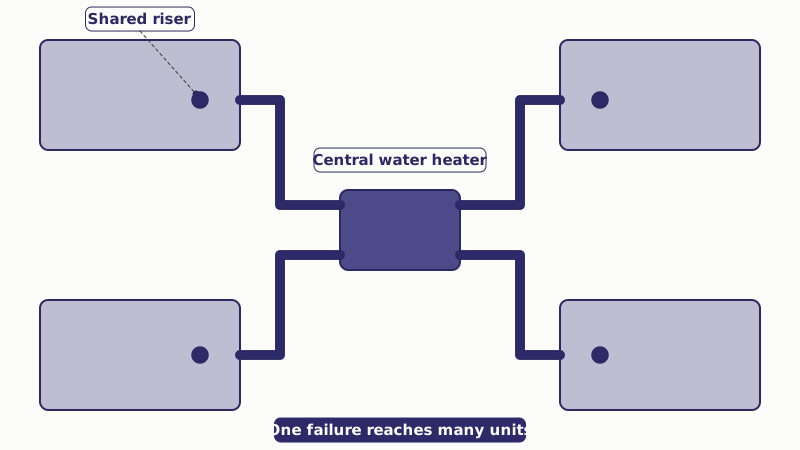
Large complexes share risers, central water heaters and stacks of drain lines, so one failure reaches many units. Typical calls are no hot water across a building, a clogged main stack backing up into a ground-floor unit, and a ceiling leak from the unit above. The person who can approve the repair is usually a manager or owner, not the tenant.
If you rent, report the problem to your landlord in writing and keep a copy. In the City of Los Angeles, rent-stabilized buildings fall under the Los Angeles Housing Department, and coverage generally depends on when a building was first built, so confirm yours with that office. Our page on no hot water in an apartment building lays out who fixes what. Managers can read about commercial plumbing service.
What about the bluff homes above Playa Vista?
The Westchester Bluffs overlook Playa Vista, and Wikipedia notes the LMU Fire Road running along them. A bluff means a change in ground height within a short distance, and static water pressure rises as the ground drops. A house low on a slope can see higher pressure than one near the top, even on the same street.
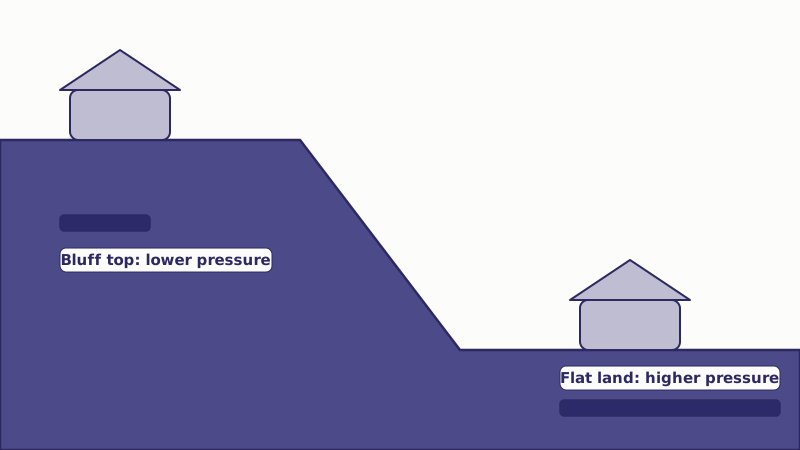
High pressure shortens the life of toilet valves, faucets and water heaters. A pressure gauge on a hose bib takes a minute, and a water pressure regulator is the usual fix when the reading is high. If the pressure is low instead, see why water pressure is low.
Did the airport change anything for Westchester homes?
Yes, in the housing itself. Jet traffic grew sharply in the 1960s, and Wikipedia reports that the city bought and condemned homes near the airport, with Westchester losing about 4,500 homes and 14,000 residents. For a plumber, the result is a patchwork: older survivors beside newer buildings, and sometimes lots whose pipes and meters were rearranged long after the original tract was laid.
If you are buying here, ask for the permit history of the house. Records on file with the Los Angeles Department of Building and Safety show which plumbing was replaced and when. A replaced water line next to an original sewer line is common in older Los Angeles neighborhoods, so inspect both.
How much does a plumber cost in Westchester?
Westchester jobs are priced like the rest of Los Angeles, with the quote driven by access, pipe age and permits. Published national guides put a typical plumber at about $100 to $200 an hour. A tank water heater swap commonly lands between $881 and $1,826, and a whole-house repipe between $4,000 and $18,000. These are guides only, and the written quote sets the real price.
Higher home values do not change the plumbing, but they change what owners decide. Repiping a 1940s house before a sale or remodel is a common call. Complex managers more often want a diagnostic first, then a priced repair list. Read what a plumber costs and water heater replacement cost for what moves a number.
Which city rules apply in Westchester?
Westchester is inside the City of Los Angeles, so water comes from LADWP, sewer service from LA Sanitation, and permits from the Los Angeles Department of Building and Safety. Work such as a water heater replacement or gas piping generally needs a permit and a contractor who holds the right state license for it. Ask LADBS what your job needs, or have your plumber confirm.
LADWP lists hardness for Western Los Angeles at an average of 8.6 grains per gallon, within a range of 5.4 to 16.1. Which supply reaches you changes the number, so scale in a water heater is worth a yearly look. Our guide to the water heater permit explains the steps.
When can a plumber get to a Westchester property?
Access depends on the building. A house needs a time window and a clear path to the water heater or shutoff. A complex usually needs the manager's approval, a gate code or a key to the utility room, and notice to tenants if the water goes off. Traffic near the airport can slow arrivals at peak hours, so late morning is easier to plan.
If water is running and you cannot stop it, close the main valve first, then call. Our page for emergency plumbing covers what to do while you wait. For a planned job, send your address and a photo through the quote page, and we will arrange the visit.
Common questions
How much does a plumber cost in Westchester?
Expect about $100 to $200 an hour from a plumber, based on published national guides, plus parts. A standard water heater replacement is often $881 to $1,826 and a full repipe $4,000 to $18,000. Westchester quotes follow the same drivers as the rest of Los Angeles, so a written quote gives you the exact figure.
Are there council rules for plumbing in Westchester?
Yes, the same City of Los Angeles rules that apply everywhere in the city. The Department of Building and Safety handles permits for work such as water heater replacement and gas piping, and some work must be done by a contractor who holds the right state license. Rules change, so ask LADBS or have your plumber confirm what your job needs before it starts.
Do Westchester apartments have different plumbing problems from houses?
Often, yes. Large complexes share risers, central water heaters and drain stacks, so one fault can affect several units. Houses have their own lines and fixtures, so problems stay local. Tenants should report issues to the landlord in writing, and managers can arrange a plumber for building-wide faults.
Should I repipe an older Westchester house?
It depends on the pipes and how they behave. Original galvanized supply lines in a 1940s house that show low pressure, rusty water or repeated leaks are usually a reason to get a repipe quote. Copper that still works may only need spot repairs. A plumber can inspect the system and tell you which case applies.