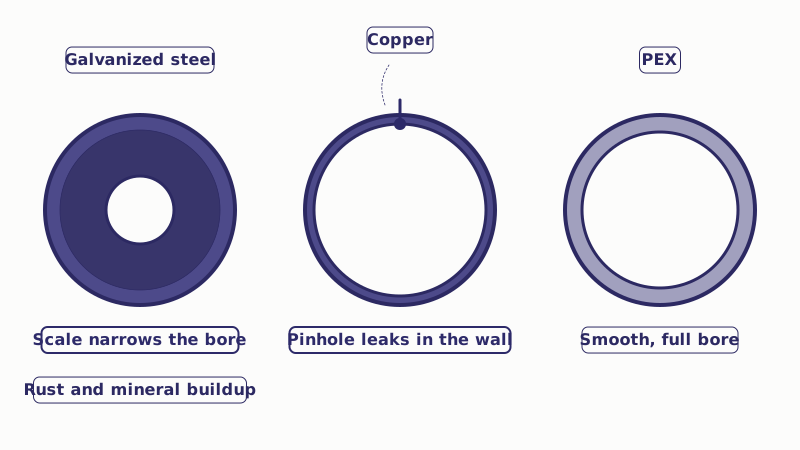
You repipe a house when the supply pipes are past saving, not because they are old. The usual triggers are galvanized steel that has rusted shut, polybutylene that is cracking from the inside, copper that keeps pinholing and pressure that has collapsed. This page is the reasoning behind the decision. The process and costs are in our main guide to repiping a house in Los Angeles.
Why do houses need to be repiped?
Because pipes wear out from the inside, where you cannot see. Galvanized steel rusts, polybutylene cracks, and copper can pinhole. When one leak follows another, or flow drops across the house, replacing the system costs less than chasing leaks and repairing wall after wall.
Los Angeles has a lot of housing from the 1920s through the 1950s, and homes from that era were commonly plumbed with galvanized steel for supply and cast iron for drains, per repipe-company descriptions of Silver Lake, Echo Park and West Adams houses. Copper became common from the late 1950s into the 1970s. Houses from about 1978 to 1995 can have polybutylene.
A repipe replaces the supply lines. Drains are separate. If the house is old enough to have failing supply lines, it is worth asking about the cast iron drains at the same time, so you can plan both.
What are the signs you need to repipe a house?
Common signs are repeated leaks in different places, brown or rusty water that does not clear, low pressure at several fixtures, stained walls or ceilings, a pipe that sweats green or blue, and a known failure-prone material. A single leak on a sound line is a repair. A pattern of leaks is a warning.
Check the water first. Run a tap for a minute. If it clears, the sediment may be disturbed pipe. If it stays brown, the line is shedding rust. Check the pressure at the tub, the kitchen and the outdoor spigot. If it is low everywhere and worse over time, corroded supply lines are a top suspect, though a failing regulator can look similar, which the page on low water pressure sorts out.
Stains on a ceiling or a damp patch in a wall can mean a slow leak inside. A plumber can use leak detection to find it, and the page on slab leaks covers the case of lines under the floor.
Which pipe materials fail, and why?
Galvanized steel rusts as its zinc wears off, usually after 40 to 60 years. Polybutylene cracks when chlorine and similar disinfectants attack it, and it can fail even in a house that is only decades old. Copper can pinhole in some water, and early plastic fittings and thin-wall pipe have their own records.
Each has a page. The steel case is on galvanized pipe replacement and the plastic case is on polybutylene pipe replacement. Copper pinholes are on the page about repairing pinhole leaks.
Water matters. LADWP reports hardness from about 9 grains per gallon in the Valley and Western LA to about 16 in Eastern LA and the Harbor, and says it is expanding chloramine across its system. Hard water leaves scale, and the disinfectant is what hurts polybutylene. Neither is a reason to panic, but they explain why the same pipe lasts longer in one house than in the one next door.
How often does a house need to be replumbed?
There is no set interval. Rough lifespans from published sources are 40 to 60 years for galvanized steel, 50 to 70 for copper and 40 to 50 or more for PEX, and each moves with water chemistry and installation. A house is due when its pipes start failing, not on a birthday.
In practice most owners deal with it once in the life of a house, often after buying an old one. A 1950s house with original galvanized pipe is well past the window. A 1990s house with copper may be fine for decades. A 1980s house with polybutylene is a replace-now case because of the failure mode.
If your house has had one repair, ask the plumber what they saw inside the cut pipe. Thick scale, thin walls and pitting say the rest of the line is similar. A clean cut says one failure may be just that.
Is a repair enough, or do you need a full repipe?
A repair is enough when the failure is a single joint, a freeze or a nail through a young, sound line. A repipe is the answer when the same line keeps failing, the material is known to fail or the pressure is gone. A partial repipe of the worst section is a middle path.
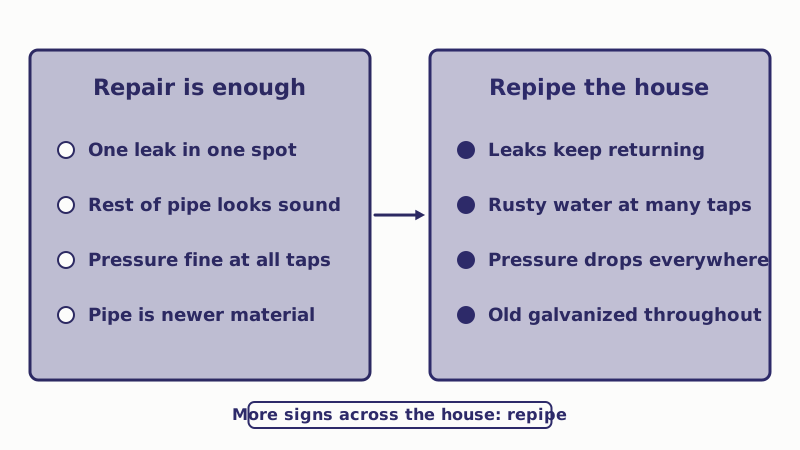
Ask the plumber for the options in writing: repair, partial repipe and full repipe, with a price each. Spot repairs on old galvanized steel are especially unreliable, because disturbing a rusted fitting often breaks the next one. For copper, the page on copper pipe leak repair covers what a good repair looks like.
For old houses, the page on replacing plumbing in an old house looks at the wider job, including what else is behind the wall.
What does it cost, and what else does a repipe involve?
About $4,000 to $10,000 for PEX and $8,000 to $18,000 for copper on a 2,000 square foot, two-bath house, per published guides, plus a LADBS permit and inspection. Labor is the largest share, and access, foundation type and wall patching move the number. A written quote after a visit is the real figure.
Insurance is part of the decision. Some insurers decline or surcharge polybutylene, according to inspector and repipe-company guidance, so ask yours. A permitted, inspected repipe also helps at resale. The full breakdown is on the repipe house cost page, and the pipe choice is on PEX versus copper.
Common questions
How do I know if my house has galvanized pipes?
Galvanized pipe is dull gray, magnetic and threaded at the joints. A magnet sticks to it and not to copper or plastic. Look at the water line where it enters the house, under sinks and near the water heater. Houses built before the 1960s are the most likely to have it.
Can I just repair one pipe instead of repiping?
Yes if the rest of the system is sound, and it is the right call for a single failure. If the pipe is old galvanized steel, or the same line keeps leaking, repairs buy little. Ask the plumber to show you the inside of the cut section and to quote the repair and the repipe side by side.
Is it worth repiping an old house?
Usually, if the pipes are failing or are a known problem material. Repiping stops the leak cycle, restores pressure and clears rusty water, and a permitted job helps with insurance and resale. If the pipes are sound, it may not be worth it, and a plumber should say so.
How long does a repipe take?
The plumbing commonly takes one to three days with PEX and three to seven with copper, per published timelines. Add the rough inspection and wall patching and the whole project often takes a week or two. Water is usually off for part of each working day.
Does a repipe need a permit in Los Angeles?
Yes. Replacing water supply lines in a Los Angeles house needs a LADBS plumbing permit and an inspection before walls close. The plumber normally pulls it and books the inspection. Ask for the permit to be listed in the quote, and check the plumber's license at cslb.ca.gov before you sign.
For a price on your own house, use the quote page and a local plumber will come to you.